

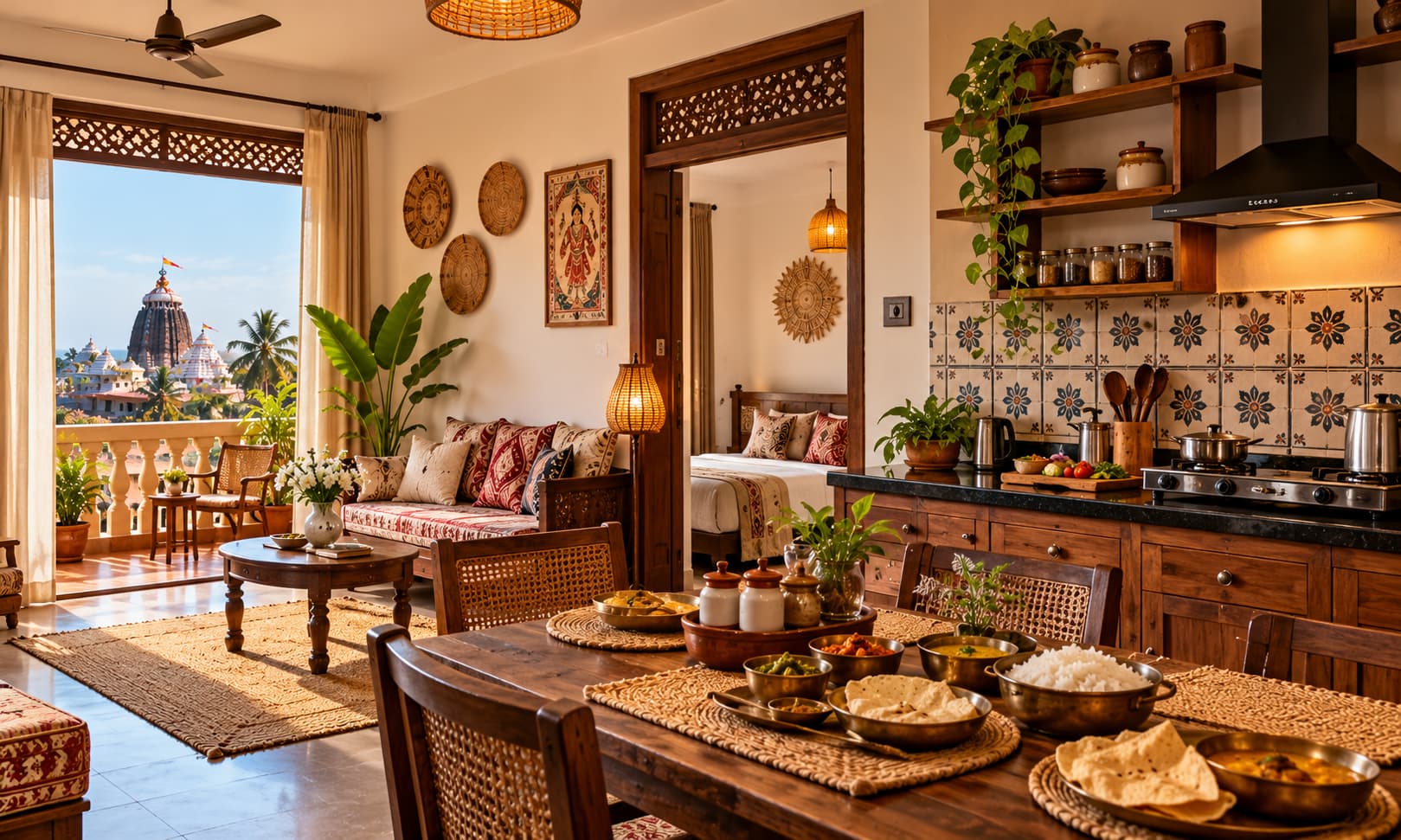
A homestay in Puri with a kitchen lets your family or pilgrim group eat what you are used to, when you want it, without leaving the room, and that is why so many of them choose it over a standard hotel room.
Puri is a town that runs on the rhythm of the temple. Darshan can mean a pre-dawn start, a long wait in a queue and a late return. Children get hungry at odd hours, elders follow strict diets, and many pilgrims observe food customs that a hotel menu cannot always match. A kitchen turns the stay from a place to sleep into a place to recover.
This guide explains what a kitchen really adds, who benefits most, and what to check before you book. If you are still comparing hotels, homestays and cultural stays, start with our guide to where to stay in Puri.
The quick answer
- Families get home-style meals for children and elders, extra space, and fewer restaurant bills over a multi-day trip.
- Pilgrims can follow their own food customs and fasting rules, and rest between long darshan days.
- Longer stays become easier and more affordable, because you are not eating every meal out.
What a kitchen actually gives you in Puri
A kitchen gives you control over food, timing and budget, which are the three things that matter most on a long, tiring temple trip.
Food you trust. Not every traveller is comfortable with restaurant food for several days in a row. With a kitchen you can cook simple, familiar meals, choose your own ingredients and keep to your family’s habits, whether that is plain khichdi, dalma, rice and dal, or a quick breakfast before darshan.
Meals on your schedule. Temple days start early and run late. A kitchen lets you make tea at 4 a.m., warm milk for a child, or prepare a light meal after a long walk, without waiting for a restaurant to open.
Gentler on health. Elders with dietary restrictions, children with fussy appetites and anyone who has had an upset stomach from travel can eat what suits them, which keeps the trip comfortable.
Better value over several days. Hotel meals for a family add up quickly. Cooking even one or two meals a day, with simple groceries from the local market, can noticeably lower your total trip cost. Compare the full cost for your group, not just the room rate.
A home to return to. A kitchen makes a room feel like a home, which is why guests tend to relax, linger over tea and enjoy the evenings.
Why families prefer a homestay with a kitchen
Families prefer a kitchen homestay because it solves the daily problems of travelling with children and elders: food, rest and space.
- Children eat on time. Toddlers and school-age kids do not wait politely for a restaurant. A kitchen means warm milk, simple meals and snacks are always possible, and bedtime stays on track.
- Elders eat what suits them. Grandparents with diabetes, low-salt diets or simple vegetarian preferences can have their own food, cooked the way they like it.
- Everyone shares one space. Joint families and multi-generation groups can stay together, sit together and cook together, instead of splitting across several hotel rooms.
- Evenings feel like home. After a day of temples, crowds and travel, a quiet living space and a cup of tea often matter more than a hotel lobby.
- Fewer restaurant decisions. There is no daily debate about where to eat, which saves time, money and patience.
For a family trip to Puri, the real luxury is not a bigger room. It is being able to feed everyone calmly, on time and the way they are used to.
Why pilgrims prefer a kitchen homestay
Pilgrims prefer a kitchen homestay because it respects food customs, supports long and early darshan days, and gives a quiet place to rest and reflect.
Puri is one of India’s four Char Dham pilgrimage sites, and many visitors come for several days to attend darshan, visit the Gundicha Temple, take part in festivals and travel to nearby sites. For them, the stay is part of the pilgrimage.
- Food customs are easy to follow. Many pilgrims prefer simple vegetarian meals, avoid certain ingredients or observe fasts. In your own kitchen, you decide what goes into the pot and how it is cooked.
- Early starts are normal. Temple visits often begin before sunrise. With a kitchen, a warm drink and a light bite are ready before you leave.
- Rest between long days. After hours in queues and crowds, a calm space with food ready is better than searching for a restaurant.
- Groups stay together. Pilgrim groups, relatives and friends can share one property and one kitchen, which keeps the trip simple and the costs shared.
- Longer stays are practical. Pilgrims who stay a week or more, for festivals or a series of rituals, save considerably when they can cook some of their own meals.
- Mahaprasad stays special. You can still taste the temple’s Mahaprasad, and your kitchen takes care of everything else, such as tea, breakfast and simple dinners.
If your visit is around the Rath Yatra, a stay near the Gundicha Temple lets you be close to the festival route while returning to a quiet kitchen and a comfortable room.
Hotel room vs homestay with a kitchen
A hotel room is convenient for a short halt, while a homestay with a kitchen works better for families, elders and multi-day pilgrimages.
| What you compare | Standard hotel room | Homestay with a kitchen |
|---|---|---|
| Meals | Restaurant or room service, fixed menu and timings | Cook when you like, or eat out when you prefer |
| Early temple mornings | Depends on restaurant hours | Tea and a light meal ready before you leave |
| Children and infants | Limited options for warm milk and snacks | Easy to prepare simple food at any hour |
| Elders with dietary needs | Menu-dependent | Food cooked to suit their diet |
| Space for a family | Often two rooms | One larger unit or several in one property |
| Cost over several days | Meals add up | Cooking some meals lowers the total |
| Pilgrim food customs | Hard to guarantee | Fully in your hands |
| Services | Reception, room service, restaurant | Personal host, limited on-site services |
| Best for | One-night halts, resort-style trips | Families, pilgrims, longer stays |
A kitchen at ARKA by Utkalio: the 2BHK unit and the Nilakandara room
At ARKA by Utkalio, our 2BHK unit and the Nilakandara room each have their own kitchen, because we believe a stay in Puri should feel like a home that looks after you.
ARKA is a boutique cultural homestay near the Gundicha Temple, with five rooms named after mythological and literary references such as Nabagunjara, Gita Govinda and Mahodadhi. The names carry the story of Odisha. Where there is a kitchen, it carries the warmth of a home. Together, they are meant to make your stay feel less like checking into a room and more like being welcomed into a household.
Here is what a kitchen means for different guests. If cooking matters to your trip, book the 2BHK unit or the Nilakandara room:
- A family with children can prepare a warm meal at any hour and keep to bedtime routines.
- Grandparents can eat food cooked the way they are used to.
- A pilgrim group can plan simple, familiar meals around darshan timings.
- A long-stay guest, writer or remote worker can settle in, cook a few meals and treat Puri like a second home.
A kitchen does not replace Puri’s food. Odia cuisine, the temple’s Mahaprasad and the street food of the town are part of the visit. It simply gives you the choice.
Frequently asked questions about kitchen homestays in Puri
Why do families prefer a homestay with a kitchen in Puri?
A kitchen lets families feed children and elders on time, with food they are used to, and saves the cost of eating every meal out. It also gives everyone a shared space to relax in.
Is a homestay with a kitchen good for pilgrims?
Yes. Pilgrims can follow their own food customs and fasting rules, prepare early-morning tea or a light meal before darshan, and rest comfortably between long temple days.
Is a kitchen homestay cheaper than a hotel in Puri?
Often it is better value for families and groups, especially over several days, because you can cook some meals yourself. Compare the total cost for everyone, including food, not just the room rate.
Can I still eat Mahaprasad and local food if my homestay has a kitchen?
Yes. A kitchen gives you the choice to cook or eat out. You can enjoy the temple’s Mahaprasad, Odia dishes and street food, and cook when you prefer something simple.
Do I need to bring my own groceries and cooking items?
Ask the property what the kitchen includes. Many provide basic utensils and appliances, and you can buy groceries from the local market. At ARKA by Utkalio, the 2BHK unit and the Nilakandara room have their own kitchens.
Which homestay in Puri is close to the Gundicha Temple?
ARKA by Utkalio is a cultural homestay near the Gundicha Temple, with a kitchen in its 2BHK unit and in the Nilakandara room, which makes those options convenient for families and pilgrims who want to be near the Rath Yatra route.
How early should I book a kitchen homestay in Puri?
Book as soon as you know your dates. Homestays have few rooms and sell out early, especially from October to February and around the Rath Yatra.
Families and pilgrims choose a homestay with a kitchen because it makes a demanding trip simpler: food on time, space to rest, and costs that stay under control. The room is where you sleep, but the kitchen is where the stay becomes a home.
If you are planning a family trip or a pilgrimage to Puri, we would love to host you at ARKA by Utkalio, a cultural homestay near the Gundicha Temple with a kitchen in its 2BHK unit and in the Nilakandara room.
Message us on WhatsApp or book directly through our website to check dates for your visit.