

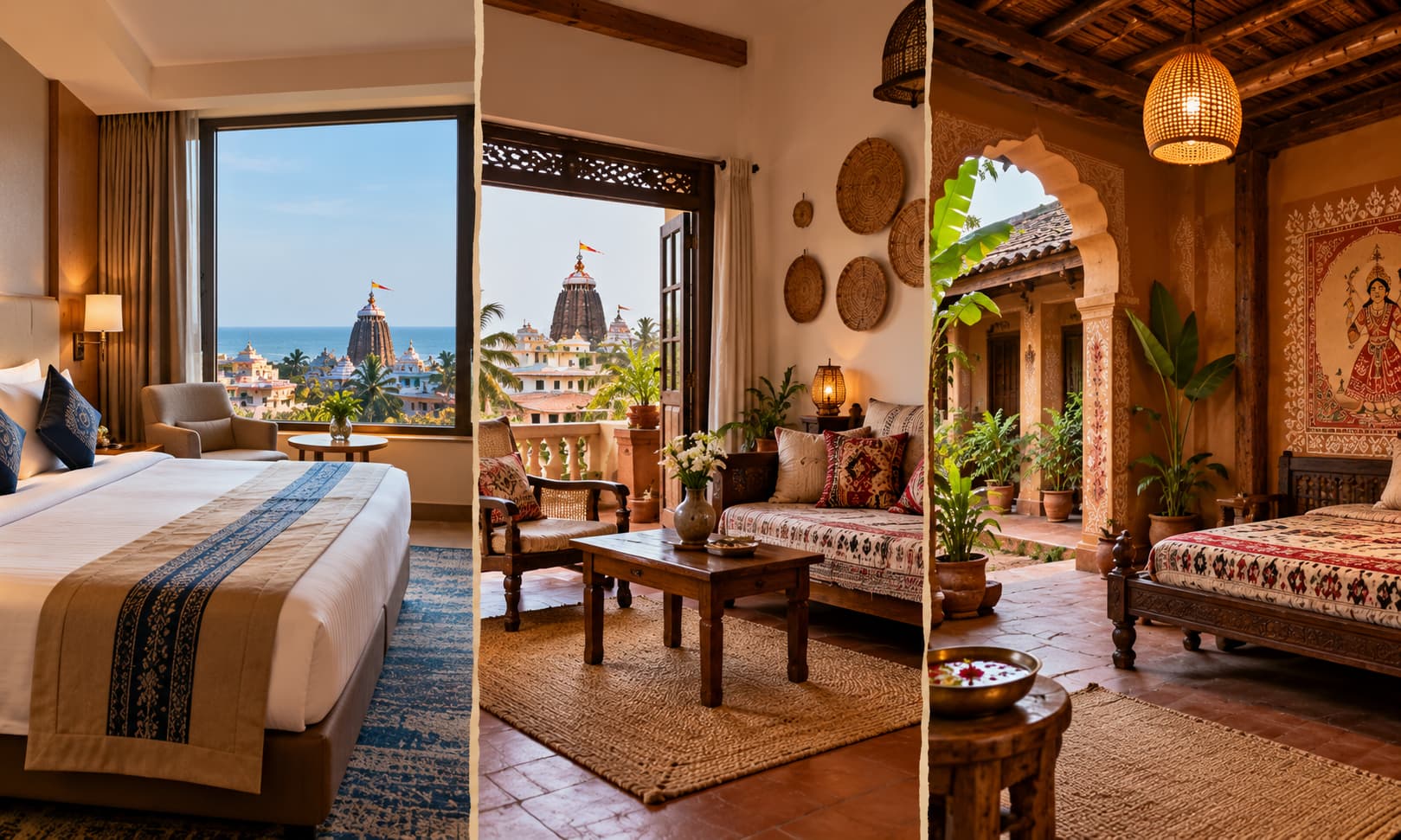
Which type of stay is right for your Puri trip?
The right stay in Puri depends on what you want from the trip: a hotel for standard services and easy beach access, a homestay for space, home-style food and a kitchen, and a cultural stay for a trip that feels like Odisha from the moment you wake up.
Puri is not a typical beach destination. It is one of India’s four Char Dham pilgrimage sites, home to the Jagannath Temple and the Rath Yatra, and it sits within easy reach of the Sun Temple at Konark, the artist village of Raghurajpur and Chilika Lake. People arrive as pilgrims, as large joint families, as couples, as solo travellers and as remote workers, and each of them wants something different from a room.
The most pleasant season is October to February, when the weather is cool and the sea is calm. It is also when good stays fill up first. This guide compares the three kinds of accommodation in Puri so you can decide before you book.
The quick answer
- Choose a hotel if you want predictable services, an in-house restaurant and a beachfront address, and you plan to be out all day.
- Choose a homestay if you are travelling with family or a group, want more space and a kitchen, and prefer a personal host to a front desk.
- Choose a cultural stay if you want the place itself to be part of the experience: Odia design, stories, food and hosts who can guide you through the town.
Hotels in Puri: what to expect
Hotels give you the most predictable stay in Puri, from budget lodges close to the temple to larger resorts along the beach, with many of the hotels and restaurants clustered on the Swargadwar beachfront and the resort belt toward Baliapanda.
You get a front desk, scheduled housekeeping, an on-site restaurant, parking in many properties and the ability to book several rooms at once. For a one-night halt or a tightly planned pilgrimage, that reliability is exactly what many travellers need.
What works well
- Standard services, from reception to housekeeping, that you can count on.
- Beachfront and resort options with in-house dining.
- Easy bookings for large groups and tour operators.
- Clear price tiers, so you know roughly what you are paying for.
What to weigh
- Rooms are standardised, so the stay could be in any coastal town in India.
- Beachfront and temple-side hotels get crowded and noisy in peak season and during festivals.
- Meals usually come from a fixed menu, with little room for home-style Odia food.
- Families often need two rooms, which raises the cost.
Best for: short stops, large groups that need many rooms, and travellers who value a familiar brand or a pool and restaurant on the premises.
Homestays in Puri: what to expect
A homestay in Puri is a smaller, owner-run property where the host is personally involved in your stay, so service feels like hospitality rather than a script. Across India, homestays have moved from a niche choice to one of the fastest-growing travel segments, as travellers look for local, experience-led stays over standardised ones. A 2026 study of Kerala accommodation in the journal Atithya found that homestays gave guests more authentic cultural experiences than hotels.
In Puri, that usually means more space for the same money, flexible meals, and a host who can tell you which lane to walk, which sweet to try and when to avoid the crowd.
What works well
- More room for families and groups, often with a kitchen or kitchenette.
- A personal host who gives real local directions, not a brochure.
- Quieter surroundings than the busiest hotel strips.
- Money that stays with local families.
What to weigh
- Quality varies from one homestay to another, so recent reviews and honest photos matter.
- There is usually no 24-hour restaurant or round-the-clock reception.
- With only a few rooms, the best homestays sell out early in the season.
Check before you book a homestay
- Recent guest reviews and photos that match the listing.
- A host you can reach on WhatsApp or phone before you pay.
- Whether a kitchen, parking, hot water and power backup are included.
- The exact distance to the Jagannath Temple and the beach, by road.
Best for: families, multi-generation groups, longer stays and travellers who want a calmer base.
Cultural stays in Puri: when the room is part of the journey
A cultural stay is a homestay-style property designed around local heritage, where the architecture, art, room names, food and hosts all carry the story of the place. It is not a hotel with a few paintings on the wall. The culture is the reason the property exists.
This is the idea behind ARKA by Utkalio, a boutique cultural homestay in Puri, Odisha, close to the Gundicha Temple. Each of our five rooms is named after a mythological or literary reference from Odia and Indian tradition:
- Nabagunjara, the composite creature of Odia folklore and the Odia Mahabharata.
- Gita Govinda, named after Jayadeva’s poem of devotion, which is closely tied to the Jagannath tradition.
- Mahodadhi, the “great ocean” that Puri’s sea has been called for centuries.
Every unit also has its own kitchen, because a stay should feel like a home that looks after you, not a room you leave every morning and return to every night.
What a cultural stay adds
- Stories behind the place, so the temple, the sea and the festival calendar make more sense when you step out.
- Hosts who can guide you on Odia food, local crafts and which lanes and timings suit your plans.
- A base near the Rath Yatra route and the Gundicha Temple, away from the loudest part of the beachfront.
- A design you will remember, not a room you will forget.
What to weigh
- With fewer rooms, a cultural stay needs earlier booking, especially from October to February and around Rath Yatra.
- It is built for slow, meaningful travel, not for nightlife or resort-style entertainment.
Best for: first-time visitors who want context, families travelling with children and elders, Odia and NRI guests reconnecting with their roots, and writers, photographers and creators who want a base with character.
Hotel vs homestay vs cultural stay: side-by-side comparison
A hotel wins on predictable services, a homestay on space and personal hosting, and a cultural stay on meaning and local insight.
| What you compare | Hotel | Homestay | Cultural stay |
|---|---|---|---|
| Feel of the stay | Professional and standardised | Warm and personal | Rooted in Odia heritage and story |
| Space for families | Often two rooms needed | Larger units, sometimes a kitchen | Larger units, kitchen in every ARKA unit |
| Food | On-site restaurant, fixed menu | Home-style meals or your own cooking | Home cooking plus guidance on Odia food |
| Local guidance | Front desk or travel desk | Host tips | Host tips with cultural context and stories |
| Atmosphere | Busy, especially on the beachfront | Quiet and neighbourly | Calm, with character |
| Services | 24-hour reception, restaurant, often parking | Limited, host-dependent | Limited, host-led and personal |
| Booking in peak season | Easier to find rooms | Sells out early | Sells out early, so plan ahead |
| Best for | Groups, short halts, resort lovers | Families, longer stays | Culture seekers, first-timers, families, creators |
Where in Puri should you stay, and when?
The best area depends on whether you want to be near the temple, near the sea or near the Rath Yatra route, and the best season is October to February.
Near the Jagannath Temple. You can walk to darshan, and the lanes around the Grand Road are full of life. Expect crowds, narrow roads and difficult parking, especially on festival days.
On the beachfront. The Swargadwar stretch is the tourist hub, lined with hotels and restaurants facing the sea. It suits beach walks and easy dining, and it is the busiest and noisiest part of town in peak season. Puri’s Golden Beach is also a Blue Flag beach, which helps explain its popularity.
Toward Baliapanda. Resorts here trade walkability for a calmer, more spread-out stay.
Near the Gundicha Temple. The Gundicha Temple sits roughly 3 km from the main temple along the Grand Road, the route the chariots take during Rath Yatra. This side of town is quieter and greener, and it keeps you close to the heart of the festival without the crush of the beachfront. This is where ARKA by Utkalio is located.
Distances worth knowing. The Sun Temple at Konark is about 33 km from Puri, around an hour by road, and Bhubaneswar airport is roughly 60 km away.
When to go. October to February brings pleasant weather and a calm sea, which makes it the most popular window. April to June is hot. The Rath Yatra falls in June or July every year (it was on 16 July in 2026), and the Puri of that week is among the busiest places in India, so stays near the Grand Road are usually booked well in advance. Check the date for the year you plan to travel and reserve early.
How to choose the right stay in Puri
Match the stay to the traveller: families and culture seekers do best in a homestay or cultural stay, while large groups and short halts usually suit a hotel.
| If you are | Best fit | Why |
|---|---|---|
| A family with children and elders | Cultural stay or homestay | Extra space, a kitchen for simple meals, a calmer setting |
| A large pilgrim group (10 or more) | Hotel, or several homestay units | Many rooms under one booking, easy group logistics |
| A couple on a short beach break | Beachfront hotel or resort | Sea views, in-house dining, resort facilities |
| A first-time visitor who wants context | Cultural stay | Hosts and design that explain what you are seeing |
| An Odia or NRI guest reconnecting with roots | Cultural stay | Stories, language and food that feel familiar |
| A solo traveller, writer or remote worker | Homestay or cultural stay | Quiet, a kitchen, a host to ask for tips |
| Staying a week or longer | Homestay or cultural stay | A kitchen cuts cost and keeps meals simple |